
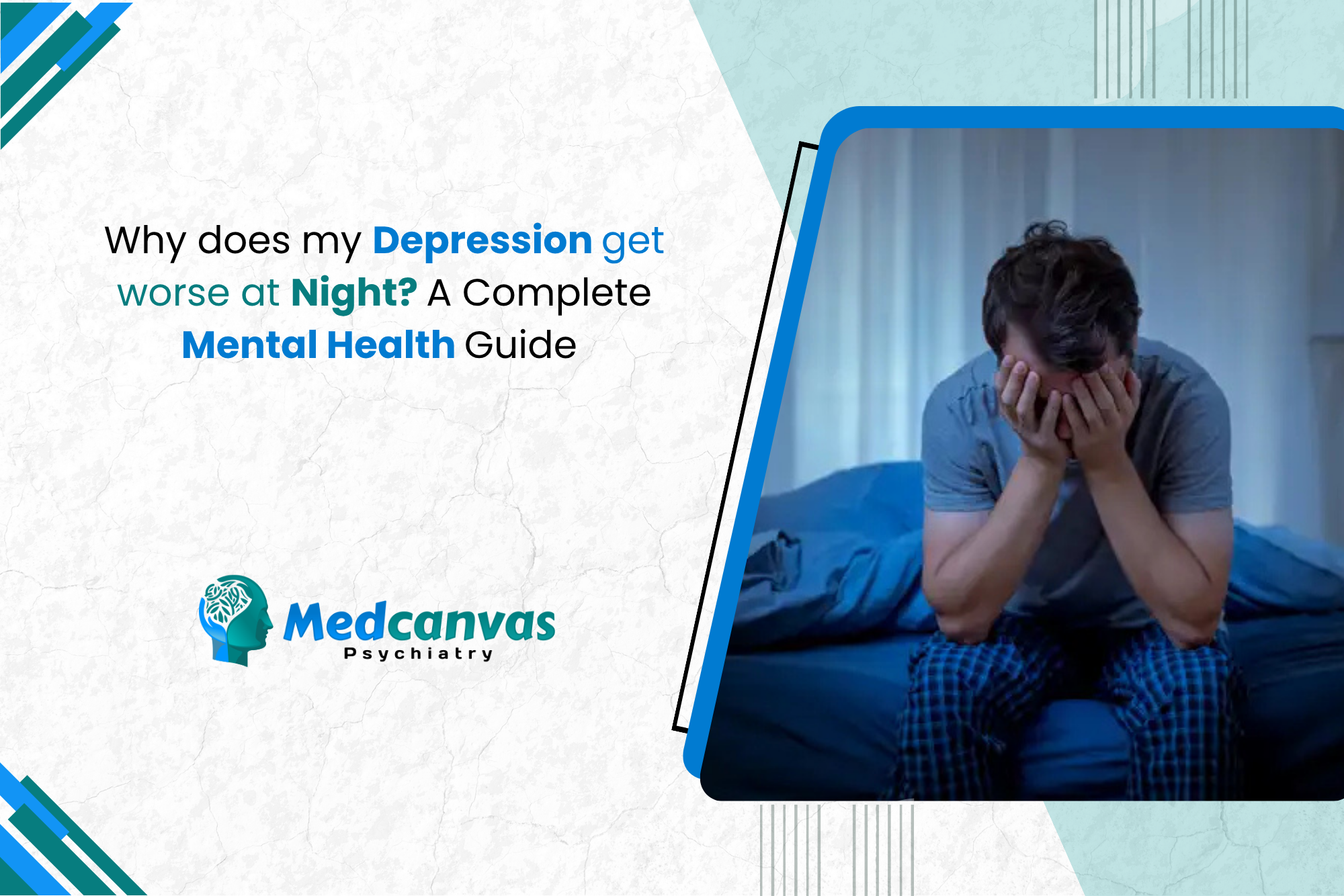
You get through the day. You probably don’t get through easily, but you do. And then the evening arrives, and the distractions wash away, and something begins to change.
The heaviness moves in. The thoughts get louder. Sleep seems out of reach and then, even when it comes, is not always restorative.
Questions like “why do I get depressed at night” or “why do I get so sad at night” are far more common than people realize. Night time depression is a well-documented phenomenon with very real reasons for why it occurs. And often understanding those reasons is the first step towards actually doing something about it.
What Actually Changes at Night
Our body is based on a circadian rhythm (our internal clock that plays a role in sleep, hormone release, body temperature and mood) happening over 24 hours.
That rhythm is often interrupted in depressed people, and these disruptions are typically more pronounced after darkness – one of the key reasons depression gets worse at night for so many people.
The hormonal shift
Cortisol, the main stress-regulating hormone of your body, is still highest in the morning and decreases naturally during the rest of the day.
That gradual decline is normal. However, for many depressed people, cortisol secretion is aberrantly regulated throughout the cycle, which clouds how resilient you feel to emotions as the day progresses.
Meanwhile, the production of serotonin in your body decreases. Serotonin is a neurotransmitter that is inherently related to mood stability, and less production can ultimately amplify feelings of sadness, hopelessness or emotional flatness in the evening hours as opposed to earlier parts of the day.
This is a direct reason why depression is worse in the evening for so many. It is not a weakness. It is chemistry, and it is biological.
The fatigue factor
By evening, the majority of us have put in hours making choices, managing relationships and responsibilities. But regulating emotions is actual cognitive labor, and by night, that battery has been drained.
The coping strategies that you can lean on during the day are much less accessible when you’re going on fumes. The thought that you can brush off at 10 AM has a much more iron grip on you by 11 PM – leaving you feeling more depressed at night than at any other point in the day.
Why Nighttime Feeds the Spiral
Rumination without interruption
The world intrudes during the day. So, some meeting, something to be done, someone asked you something. These interruptions are not always a good thing, but they have a purpose: they take you out of your head. When nighttime comes, the loop never breaks.
One of the hallmarks of depression is rumination – a pattern in which you repeatedly think about negative thoughts, worst-case scenarios and self-criticism.
When there is nothing else external to draw your attention, it gets much worse. Silence that should feel peaceful, instead is a cavern into which all of the hardest thoughts will echo.
Isolation and what it does
For many of us, the loneliest time of day is the night.
Screens provide stimulation, but not connection. And depression already tends to make people feel alienated and misunderstood, a feeling much harder to dispute when you find yourself alone in the darkness.
Social connection works to prevent ‘low mood’ empirically. Sometimes this can make an already rough evening insurmountable.
The Sleep-Depression Loop
They are feeding off one another in a cycle that is really hard to break without taking on both.
Depression alters sleep architecture by decreasing the restorative deep sleep and REM stages that support emotional processing of information in the brain. Yet chronic sleep deprivation reinforces depression by making us irritable, less able to cope with our emotions, and more hopeless.
Sleep, for many individuals, is now intertwined with a sense of dread. Feeling too sad to sleep is not a figure of speech — it is a real and documented symptom.
Lying in bed awake, dreading the day ahead and reliving the day just gone creates an association that builds, and over time makes sleep harder to reach even when the depression is mild.
What Can Actually Help
While none of the following should be a substitute for professional treatment, these are all things that truly help many people manage depression at night.
- Have a regular sleep and waking schedule, inclusive of the weekends. Routine also stabilizes the natural circadian rhythm of the body, which depression disrupts.
- No screens at least one hour before bedtime. Blue light inhibits melatonin and activates the brain in a state counterproductive to sleep.
- Build a simple wind-down routine. It need not be a long process. Ten minutes of calm and predictable tells your nervous system that the day is done.
- Write it down before bed. Even setting down your rumination for a moment can decrease its grip. There is absolutely nothing for you to solve. Just get it out of your mind and into writing.
- Stop lying awake in bed for extended periods of time. After 20 minutes or so, if you are still awake, get up and do something mellow until your eyes droop. Fighting against wakefulness in bed strengthens that negative association.
- Also, when consuming alcohol, use it in moderation. The truth is, alcohol interferes with sleep quality and can also aggravate depressive symptoms in the hours following its breakdown.
Nighttime Depression
Life has its moments of low evenings now and then. However, when it is constant, when nearly every night brings a shower of despair, intrusive thoughts or an alarming sense of dread – that information is worthwhile listening to. If your depression is worse in the eveningon a near-nightly basis, it is worth taking seriously.
Signs that you may need professional help for your nighttime depression are the following:
- Sleep feels like a punishment rather than a blessing.
- You are waking up between 3 AM and 5 AM, and your mind is already racing.
- The low mood is the next day, hindering your functioning ability.
- You are depending on the bottle or some other substances to make it through the night.
- If you are having thoughts of killing or harming yourself.
On a second note, that last one is not something to take care of by oneself. If you are feeling suicidal, please get help. You can reach the 988 Suicide and Crisis Lifeline any time.
How Medcanvas Psychiatry Can Help
Nighttime worsening depression usually responds well to a combination of medication management and therapy, which fits with the cause underlying the pattern for you.
This manifests differently from individual to individual, which is why a thorough psychiatric assessment is much more relevant than a box-ticking approach.
At Medcanvas Psychiatry, Diana Arrah offers detailed psychiatric evaluations, medication management, and evidence-supported therapeutic support for ages 6-70. Care is also offered in-person at Minot, North Dakota, and through telepsychiatry to patients statewide who require more flexible care options.
Medcanvas works directly with Aetna and Cigna, and the team is dedicated to making effective psychiatric care accessible.
If the evenings are the hardest part of your day, that is enough reason for contacting us.
Phone: 701-963-6917
Alternative: 701-857-1333
Email: contact-us@medcanvaspsychiatry.com
Location: 104 20th Ave., SW Ste. 4, Minot, ND 58701
Website: medcanvaspsychiatry.com
You do not have to keep waiting for morning to feel better.
