
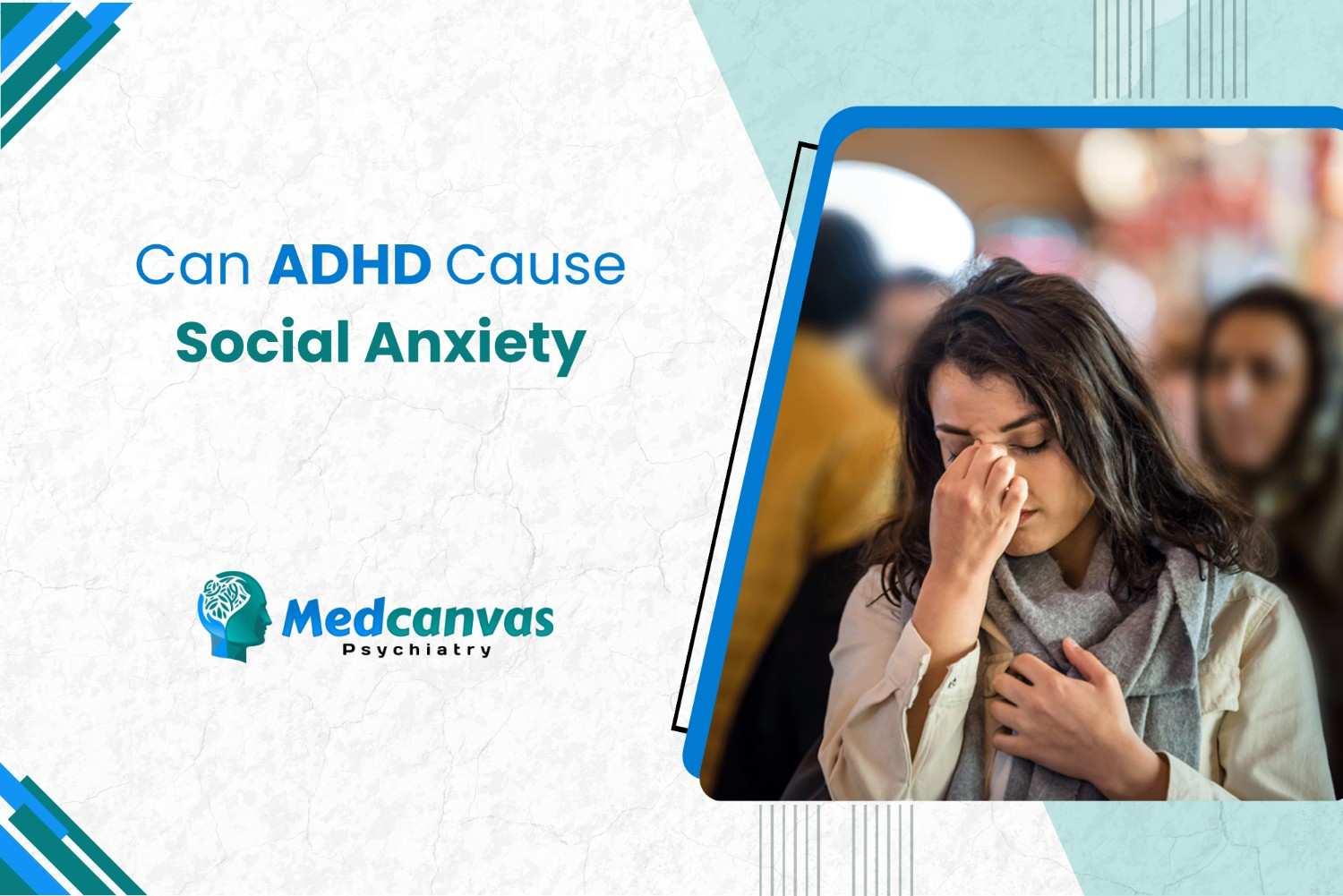
You blurt something out mid-conversation and the room goes quiet. You forget a name you should definitely know. You talk too much, then overcorrect and go silent. Later that night you are still running the whole thing back, picking it apart.
After enough of those moments, something changes. You start tensing up before social situations. You cancel things. You avoid the kinds of gatherings that used to feel fine. And at some point it stops being about the ADHD and starts feeling like something else entirely.
That something else is usually anxiety. And the connection between the two is a lot more direct than most people are told.
ADHD Does Not Come With a Social Off Switch
The thing about ADHD is that it does not just affect focus at a desk. It shows up in conversations. It makes you interrupt people because you know the thought will be gone if you wait. It makes you lose the thread of what someone was saying while you were figuring out your response. It makes you miss the moment when the energy shifted and everyone was quietly ready to move on.
Those are not personality problems. They are what ADHD looks like in real time, in a room full of people. But nobody around you is thinking about your neurology. They are just noticing that something felt a little off.
You notice too. And over years of noticing, something starts to form. A low-level anticipation that things will go sideways. A hyperawareness of how you are coming across. A habit of pre-checking everything before you say it, then second-guessing it anyway.
That is anxiety. Built slowly, out of real experiences. And it is genuinely common.
How the Anxiety Actually Gets Built
The years add up
Nobody develops social anxiety from one bad conversation. It builds over time, usually from a pattern that starts early. The kid who got shushed constantly. Who kept accidentally hurting people’s feelings and had no idea how. Who got labeled difficult or intense or too much before they were old enough to understand what was actually happening neurologically.
By the time that kid is an adult, they have a long history with social situations going wrong in small but consistent ways. The brain does what it is designed to do with that information: it starts treating social situations as something to be wary of. That is not a flaw. That is how learning works. The problem is that the learned response outlasts the situation and starts running the show.
Rejection sensitivity
A lot of people with ADHD experience something called rejection sensitive dysphoria. It is not in the formal diagnostic manual but clinicians see it constantly. What it means is that perceived rejection or criticism hits with a force that most people would find hard to understand.
A short text reply. A friend who seems quieter than usual. Being left out of a plan. For someone with rejection sensitivity, these land less like minor social friction and more like something genuinely painful and hard to shake.
Layer that on top of ADHD, where social missteps happen more frequently and feel harder to control, and you have a situation where social life starts to feel genuinely risky. The natural response is to pull back. And pulling back is exactly how social anxiety digs in.
Why People Get One Diagnosis and Miss the Other
ADHD and social anxiety look a lot alike from certain angles. Both can make someone go quiet in a group. Both can make someone seem distracted or checked out. Both can look like not wanting to be there.
What a lot of clinicians miss is that when both are present, the picture does not look like a clean version of either one. It looks like someone who is struggling in ways that do not fully add up under just one label.
The person who has been told they have anxiety but the anxiety treatment is not really sticking. The person who got an ADHD diagnosis and the medication helped with focus but they still feel weird and tense in social situations. The person who has tried to explain what is happening and keeps feeling like the explanation does not quite fit.
These are often people dealing with both, without anyone having put it together clearly.
What This Looks Like Day to Day
When ADHD and social anxiety are both in the picture – certain patterns show up pretty consistently:
- One-on-one is manageable. Groups are draining in a way that is hard to pin down.
- You rehearse things before you say them and you still feel like you got it wrong.
- You go over conversations after they happen looking for the moment you misread something.
- You have started avoiding things you used to do without thinking twice.
- Familiar settings feel fine. New people or new situations bring on a tension that kicks in before anything has even happened.
Treating One Without the Other
This is where getting the diagnosis right actually matters in a practical way.
Medication for ADHD can reduce the frequency of the social slips that feed the anxiety. Executive function improves, conversations get easier to track, the moments that used to go sideways happen less. But the anxiety that was built over years does not just dissolve because the ADHD is better managed. It has its own momentum now.
Treating the anxiety without addressing the ADHD leaves the original source of the problem still running. You might learn strategies in therapy, but the neurological stuff that kept producing the difficult moments is still there underneath.
Both need to be on the table. That requires a clinician who is actually looking for both rather than stopping at the first explanation that fits.
Getting Evaluated at Medcanvas Psychiatry
Diana Arrah at Medcanvas Psychiatry works with adults and adolescents across the full picture, including cases where ADHD and anxiety are tangled together in ways that have not been clearly sorted out before. The evaluation process is thorough because a quick assessment is how things get missed.
Care is available in person in Minot, North Dakota and via telepsychiatry statewide. Medcanvas accepts Aetna, Cigna, and most major insurance plans.
If you have spent time wondering why social situations feel harder than they should, that question deserves a real answer. Call or email to schedule your evaluation.
Phone – 701-963-6917
Alternative – 701-857-1333
Email – contact-us@medcanvaspsychiatry.com
Location – 104 20th Ave., SW Ste. 4, Minot, ND 58701
Website – medcanvaspsychiatry.com
Most people spend years assuming this is just how they are. It usually is not.
