
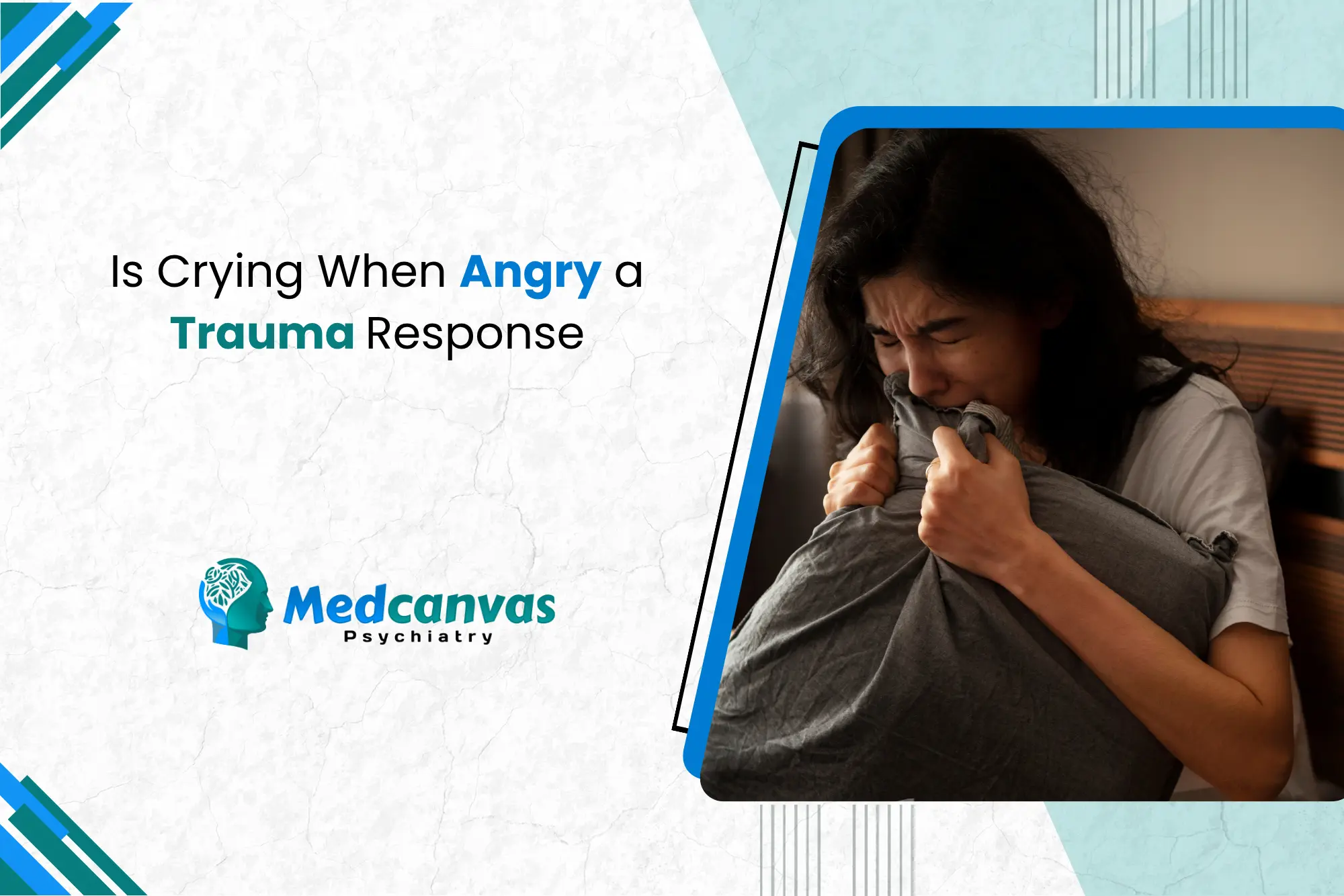
This is a situation that most people are very familiar with, but no one is really talking about. You are in the same fight. You are not sad. You are not hurt. You are just furious. Then your eyes flood.
That is one of the oddest things our bodies can do, crying and being enraged at once. It feels like a betrayal. You were trying to hold the line, and then – you appear to be losing it all. The anger remained, all present and accounted for, buried just below the tears.
This is something everyone assumes is a them problem. A sensitivity thing. A wiring flaw. They fear it, and in some cases go out of their way to avoid conflict entirely to avoid repeating the same mistake.
What they rarely take into consideration is the fact that this could be the body informing them of something worthwhile hearing.
Your Body Keeps Score, and Sometimes It Cries
The tears of anger are not random. There is a logic to them, even if that logic dwells beneath awareness.
Anger and overwhelm have a common neural estate. The system starts looking for a release valve when an emotion is so large that it has nowhere to go. And for those of us who were taught to discover that if we expressed anger directly, there would be trouble, whether because it was acknowledged, ridiculed, or never modeled as a safe and normal thing.
This is trauma anger doing what it was trained to do: redirect.
It is worth sitting with that for a second. If you grew up somewhere that made direct anger feel unsafe, your body found a way to express it anyway. That is not weakness. That is adaptation. Messy, inconvenient, sometimes professionally embarrassing adaptation, but adaptation nonetheless.
Trauma Crying vs Normal Crying: They Feel Different From the Inside
There is a difference, and most people who have experienced both can tell you it is real even if they have never had words for it.
Trauma crying vs normal crying comes down to source and sensation. Normal crying tends to feel proportionate. Something genuinely sad or painful happens, tears come, and usually some release comes with them. There is a before and after. You feel the thing, you cry, it moves through.
The crying that comes with anger rooted in trauma does not feel like that. It arrives fast, almost ahead of conscious thought. It does not bring relief. If anything it piles on, because now you are angry and you are crying and you feel out of control and ashamed of that, all within about forty-five seconds.
It also tends to get triggered by specific things. Not just any conflict, but the particular flavors of conflict that echo something older. A dismissive tone. Being talked over. Feeling like your version of events does not count. The body recognizes those patterns before the mind does, and it responds to what it remembers, not just to what is in front of it.
The PTSD Connection Nobody Told You About
This is one of the most overlooked PTSD symptom come as anger. When someone mentions PTSD, they think of flashbacks, hypervigilance, and nightmares. PTSD and anger are rarely mentioned in the same breath, yet that absence leaves so many people bereft of context to comprehend their experience.
PTSD anger has a specific quality. It comes fast. It seems larger than the circumstances deserve. You can be left feeling shaky or disassociated after, and typically, a wave of shame is right behind it. But this is not normal frustration gone out of control. A nervous system that has been on alert for the longest time, with a threshold of threat significantly lowered.
When post traumatic stress anger meets a system that learned not to express anger directly, you get the combination this post is about. The intensity of the response, the speed of the tears, the feeling of not being able to stop it once it starts. These are not personality quirks. They are the fingerprints of a nervous system that has been through something.
And here is what makes this particularly worth knowing: a lot of people with this pattern do not identify as trauma survivors. They have never been in a war zone. Nothing singular and obviously catastrophic happened to them. But trauma does not require a single dramatic event. Years of being made to feel that your anger was too much, or dangerous, or unwelcome, that shapes the nervous system just as thoroughly.
What Your Body Is Actually Doing in That Moment
When the brain perceives threat, the amygdala fires the stress response. In people with trauma histories, that amygdala is sensitized. It fires faster, at lower triggers, than it would in someone without that background. The prefrontal cortex, which handles things like measured language and rational thought, goes partially offline. You are left with a body that is flooded and a mind that has temporarily lost some of its more useful tools.
Tears, physiologically, are part of how the parasympathetic nervous system tries to bring things back down. Crying reduces cortisol. It activates a calming response. So in the most literal sense, your body is trying to help itself.
It is just that it is doing it at a time when crying feels like the worst possible option, which adds its own layer of stress, which makes everything worse.
This is the loop a lot of people are in. The anger, the tears, the shame about the tears, the anger at the shame, the overwhelm. Understanding where the loop starts and why it runs the way it does is genuinely the first step toward interrupting it.
Other Things That Show Up Alongside This
If this pattern is familiar, it usually does not arrive alone. Some things that tend to travel with it:
- Anger that seems too big for what triggered it, and knowing that even while it is happening
- Going completely quiet instead of expressing anger, not calm, just shut down
- A fear of your own anger, a sense that if you really let it out something bad would happen
- Apologizing right after getting angry, even when you were clearly not the one in the wrong
- Realizing hours later that what you felt in a situation was anger, because it was not available to you in real time
- Physical things during conflict: shaking, a chest that tightens, nausea, a strange sense of being slightly outside yourself
None of these are just how some people are. They are patterns. And patterns have origins.
How Long Does This Actually Last?
This is usually the question underneath the question. How long does trauma last? And the answer that nobody wants but everyone deserves is: untreated, a very long time.
The thing that generally mellows with the passage of time is also the acute forcefulness of some identifiers. But the actual circuitry, the reflexes, the triggers – they remain largely untouched until something happens to act upon them. When the right support is provided, it may look different.
The stages of trauma recovery are not linear nor uniform, but they follow a familiar trajectory: from relearning safety in your own body, to processing what precisely happened, to constructing a life
The specific pattern of crying and angry tends to shift as trauma work progresses. The threshold rises. The overflow happens less. When it does happen, there is usually more space around it to understand it rather than just drown in it. That is not a small thing.
Not Sure If Any of This Applies to You?
Some people reading this will have a flash of recognition! Others will be less certain. They sense something is off but are not sure whether what they are dealing with rises to the level of trauma or whether they are reading too much into a pattern.
An emotional trauma test or a proper psychiatric evaluation is a reasonable way to find out. Not to get a label, but to get clarity. To have someone look at the whole picture, your history, what you are experiencing now, how it is affecting your daily life, and help you understand what is actually going on.
A lot of people put this off because they do not feel serious enough to warrant help. That is the very thing that keeps people in these patterns for decades longer than necessary.
What Actually Helps
Naming it first
Understanding that trauma anger and the tears that come with it are a nervous system response rather than a character flaw changes the internal conversation. The shame softens. Not entirely, not immediately, but enough to stop making things worse. That shift is not nothing.
Learning to catch it earlier
The nervous system is faster than thought, but it is not invisible. With time and attention, most people can learn to notice the early signs of activation before the full flood hits. A tightening somewhere. A particular quality of attention. A shift in breathing. Catching it earlier gives you more choice about what happens next.
Therapy that goes to the source
When it comes to post traumatic stress anger and the pattern around that, therapy addressing the experiences that lie under it tends to be more lasting. EMDR, somatic approaches, trauma-focused CBT. They work not because they teach you how to take better care of your symptoms – which they also do – but because they shift the underlying threat landscape from which the nervous system is operating.
Medication as a support, not a solution
For some people, the baseline level of activation is high enough that it significantly slows down everything else. Medication that reduces that baseline can create enough room for the real work to happen. It is a clinical conversation, specific to each person, but it is worth knowing it exists as a tool.
A Note Before You Go
If you have been crying and angry for years and treating it as just the way you are, this is a gentle suggestion to revisit that. The people who carry this pattern longest are often the ones who are best at functioning around it. Good at their jobs, reliable, holding things together. And quietly exhausted in a way they have never quite been able to explain.
You can read more about PTSD and anger and see whether it resonates. Or you can simply talk to someone who knows how to look at all of it together and tell you what they see.
Any of those is a step in the right direction.
We are here when you are ready to take that step.
At Medcanvas Psychiatry in Minot, ND, we offer psychiatric evaluation and medication management for adults, with telepsychiatry available if you cannot come in person. We do not rush assessments and we do not deal in generic answers. If PTSD anger, emotional overwhelm, or patterns you cannot quite explain have been part of your life, we want to understand the full picture with you.
