
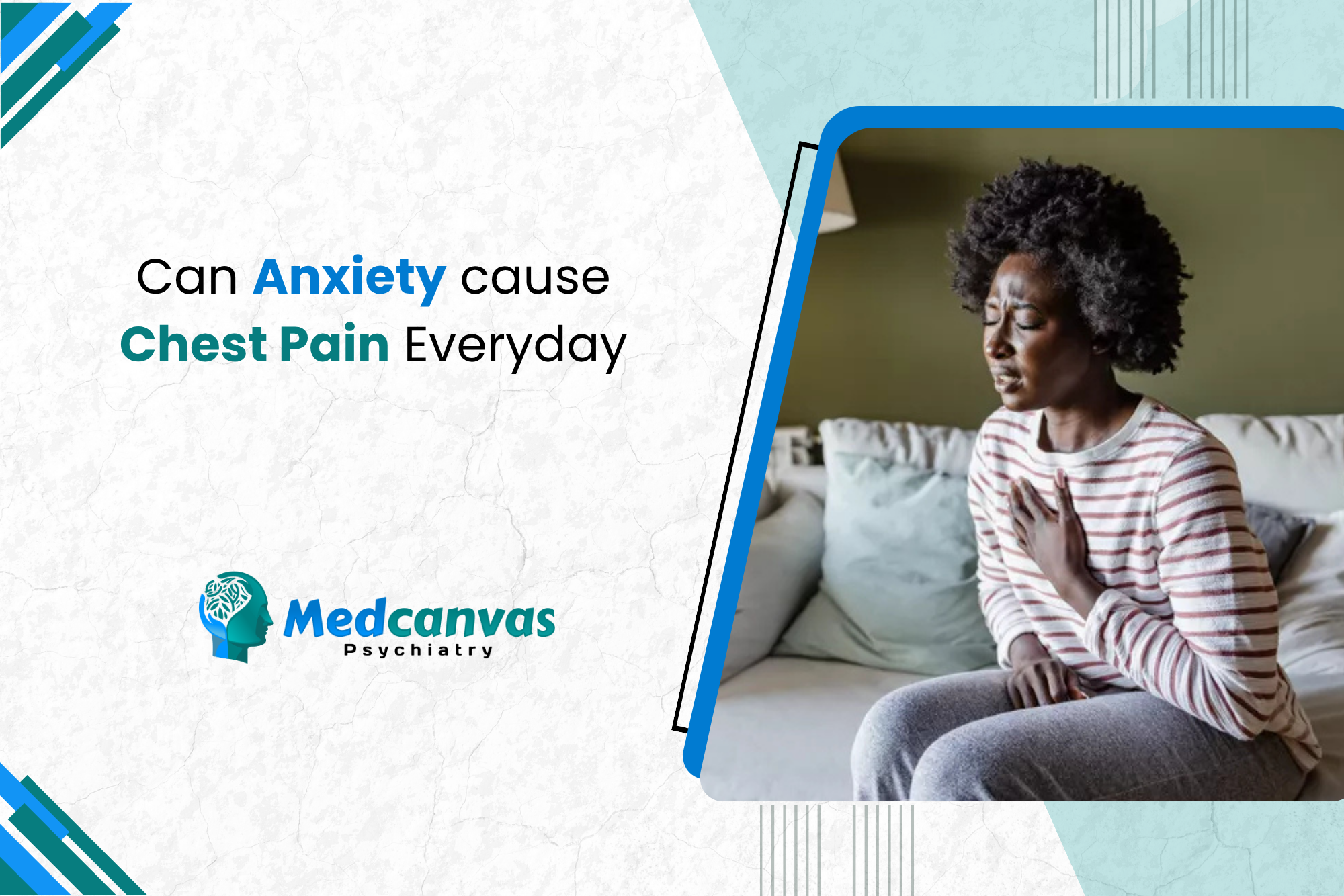
You wake up, and it is there already. That tight, heavy sensation right in the very centre of your chest. You do not have intense movement. You just woke up. And still your chest is pressed on, or it is squeezed, orness and sitting on. Some days it comes and goes. On some days, it actually does not go away.
And your first thought is likely to be the heart. That makes sense. As we have all been taught about the body, chest pain is associated with heart problems. So you get checked out. The EKG comes back fine. Blood work looks okay. Your physician tells you your heart is healthy. And that chest pain is there the next day, and the one after.
If this feels like your situation, you should definitely take a good look at Anxiety. Not simply as a convenient explanation, nor an attempt to minimise what you’re feeling, but rather – an actual physical process that causes daily chest pain in many of us. This is what is actually going on.
Can Anxiety Cause Chest Pain Every Day?
Chest pain from anxiety is real, and it can not be set in stone. It derives from the things that are done to the body under stress. If your brain has been creating hypotheticals for hours about something that is either impending or seems to be on the periphery of happening, any sort of threat perceived makes a stress response. Adrenaline gets released. Your heart rate climbs. Your breathing gets shallower. Your muscles tighten.
The chest, the intercostal muscles between your ribs, and muscle fibers around your sternum all contribute to this tension response. And if you live in anxiety, it is not just one spike but instead a baseline state that those muscles can remain partially contracted for hours or days. That constant tension is what results in the daily chest pain many people with anxiety report.
What The Anxiety Chest Pain Feels Like
A few of the confusing facets of anxiousness-related chest pain are that it does not always feel the equal manner two times. It shifts.
Some describe the feeling as a heat sensation. Some others feel a weight inside as if their chest is packed with something. Some experience a sense of constriction as though they cannot breathe deeply, no matter how hard they try.
That variability trips people up. They contends if this were anxiety, the experience would be persistent. However, anxiety itself is not consistent.
The symptoms change because the part of your nervous system from which they are arising is changing throughout the day, depending on what you are thinking, whether you got sleep, what kind of stress load you have, how much caffeine you’re drinking, and dozens of other variables.
Here are common descriptions of chest pain experienced by anxiety-related problems:
- A recurrent pressure sensation in the chest area
- Sudden sharp pain on the left side, which then starts fading again in less than 1 minute
- But with constant dull pain across the chest and especially in the morning
- Tightness that gets worse when you are in a stressful context or ruminating
- Burning or raw sensation beneath the sternum that is sometimes mistaken for acid reflux
- Pain radiating to the shoulder or upper back paired with chest pain
None of these feelings means that something is wrong with your heart. Yet they do signal that something is up, and chronic anxiety should not just be treated as a thing you need to power through.
The Origin of Anxiety’s Physical Pain
This also reflects a tendency to treat mental health as separate from physical health in an entirely unrealistic way of how the body operates.
Anxiety is not only a thought process, rationalizations, and beliefs. You are in a state of full-body physiology. The stress response affects the cardiovascular system, your respiratory system, your digestive system, and your muscular system all at once.
That response never really shuts off with chronic anxiety. The brain remains in a sort of low-grade fight-or-flight mode. Cortisol levels stay elevated. The norm is muscle tension instead of the exception. Breathing remains shallow, which lessens the amount of oxygen getting in and produces a feeling of chest tightness however, lungs are healthy.
It is worsened by a feedback loop. You feel chest pain. Your brain perceives the chest pain as a danger. That registration triggers more anxiety. The more tension, the more anxiety. If more tension is there then the chest pain increases. Well, people often do so for weeks or months without even realizing that their cycle is taking place.
When to Seek Medical Attention
This part matters. Chest pain due to anxiety DOES occur, in fact, for many people with this anxiety state it happens every day. Chest pain also indicates heart events, but the two are difficult to differentiate without a medical assessment. The rule is that you do not self-diagnose either way. Be evaluated first, particularly with new onset chest pain, accompanying shortness of breath and dizziness or if there is radiation down the left arm or jaw.
If you have gotten cleared medically and keep getting medical issues with chest pain, then the question changes. This may be a good time to see what is recruiting the existing physical symptoms.
How to Tell If Your Chest Pain Is More Likely To Be Due to Anxiety:
- The noise often gets worse when you are stressed, anxious, or trying to get the negative thoughts to stop circling in your head
- When you are distracted, relaxed or in a peaceful environment, it gets better
- You have been medically assessed and no cause of cardiac/structural nature has been identified
- And you feel other physiological anxiety symptoms, such as your heart beating fast, your breath shallow or your muscles tense
- It usually leads up a lot in the early morning or during high-stress periods
- Deep, slow breathing gives temporary relief from the feeling
Possible symptoms that require medical assistance:
- Severe or sudden chest pain, especially with sweating or nausea
- Radiating pain to the jaw, neck, left arm or back
- Chest pain with fainting or resting dyspnea
- Pain not previously checked out by a physician
- New chest pain symptoms that you haven’t felt before
Panic Attacks Stand Alone
Panic disorder – in which a person has repeated, unwanted panic attacks – is one of the most common and one of the physically most intense anxiety disorder.
with panic disorder often become fearful of the chest pain itself, which adds to their panic and perpetuates the cycle.
Knowing the panic attack is not a cardiac event does little to mitigate it in that moment. That does change the treatment pathway a little.
So, How Is The Daily Anxiety Chest Pain Treated?
What does a treatment plan for anxiety-related chest pain usually includes?
- Psychiatric eval to give the full picture, how long does it last for, what form does it take, is there anything else like depression or trauma involved
- Medication, when appropriate. SSRI and SNRI are the most common first-line prescriptions for generalised anxiety and panic disorder, which can significantly diminish psychological & physiological symptoms over time
- Therapy, especially cognitive behavioural therapy, has compelling evidence of ending the loops of thought and bodily signs that hold anxiousness alive
- Practices for breath work and nervous system regulation that reduce the activation baseline over time and have immediate effects at the tissue level in acute chest tightness
- Things like sleep, exercise and caffeine, which have a direct impact on the levels of activation of your nervous system across the day
But for most, the constant chest pain becomes substantially less as the anxiety is treated correctly. You don’t outgrow it overnight, but the highs are less intense and not as frequent. Most people describe it as transitioning into a signal more than a constant presence. They know what the feeling is when the chest tightens and how to deal with it.
Reach Out to Out Medcanvas Psychiatry
With Medcanvas Psychiatry, Diana Arrah has worked with patients to help them manage anxiety and its many physical manifestations. If you have been enduring chest pressure, a racing heart, and that pervasive background awareness that something is off, then a proper psychiatric evaluation would be the next important step.
At Medcanvas Psychiatry, we see patients ages 6 to 70 in and around Minot, North Dakota, with telepsychiatry options, so geography does not need to stand in the way of care. Your treatment is customized to your specific needs, not a one-size-fits-all checklist.
Book an appointment at medcanvaspsychiatry. com or call 701-963-6917. How you feel every day, however unpleasant, has a reason, and the answer is more straightforward than it seems.
